
Understanding where a building’s environmental impact really happens
For several years now, energy efficiency has held an important place in the construction industry. Greater insulation, high-performance envelopes, and optimized systems all help reduce energy consumption over a building’s life.
Aujourd’hui, un autre enjeu attire de plus en plus l’attention : Today, another issue is drawing more and more attention: embodied carbon.
Operational carbon: a known reality
Operational carbon refers to the emissions tied to the energy consumed over a building’s life: heating, cooling, and lighting.
These emissions can be reduced over time. You can improve energy management, replace certain equipment, or optimize mechanical systems.
The envelope plays a decisive role in this performance. A wall offering an effective R-25 with no thermal bridge, combined with significant thermal mass, directly helps stabilize the indoor temperature and reduce energy needs.
Isobloc has been acting at this level for several decades.
Embodied carbon: an impact set at the design stage
Embodied carbon is tied to the manufacturing of materials. It is generated even before the building is occupied.
Unlike operational carbon, it is locked in from construction. Once the building is delivered, there’s no going back.
In conventional concrete, the main source of emissions is cement. Even though it makes up only a portion of the mix, it generates most of the material’s carbon footprint.
As buildings become more energy-efficient, embodied carbon’s share of their overall impact grows larger.
Isobloc ZÉRO: acting upstream
Isobloc ZÉRO acts directly on this lever.
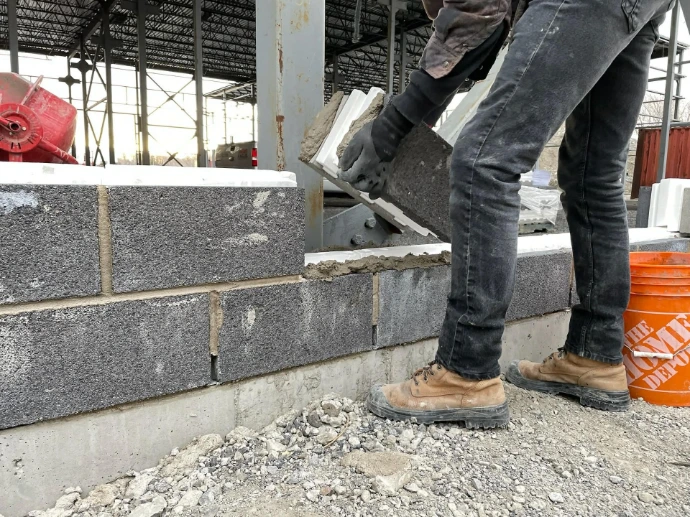
Thanks to CarbiCrete technology, cement is replaced by steel-mill residues and the manufacturing process captures CO₂.
The result:
Jusqu’à Up to 95% fewer emissions compared to a standard concrete block. de réduction des émissions comparativement à un bloc de béton standard.
Chaque mètre carré de mur permet également de détourner Each square metre of wall also diverts 43.75 kg of steel slag from landfill. de scories d’acier de l’enfouissement.
The technical performance stays identical:
1
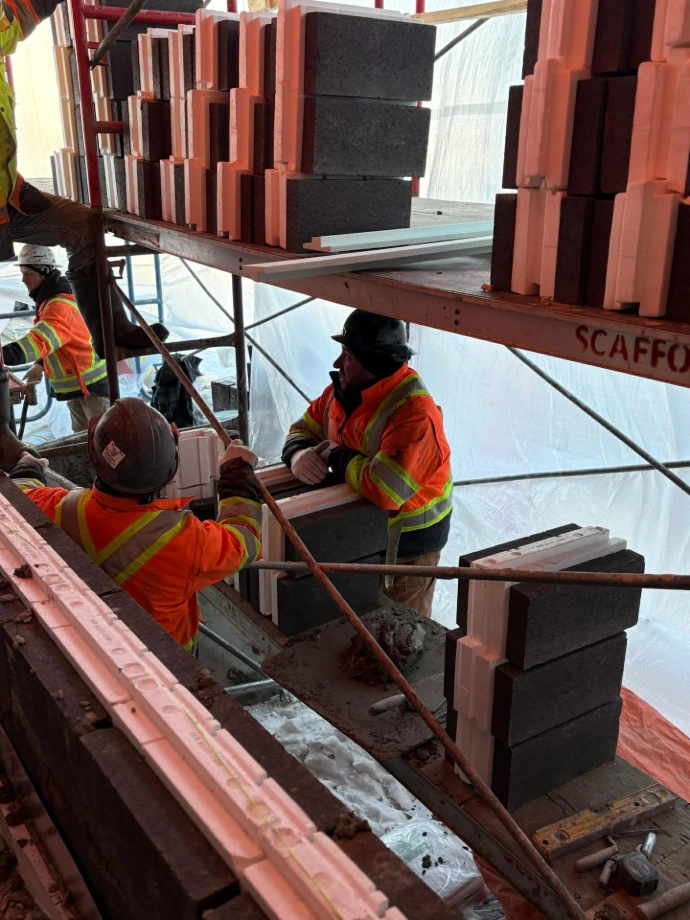
Effective R-25 with no thermal bridge
2
50-year warranty
3
Impact-resistant
4
Repairable
5
Maintenance-free

6
ULC 2-hour fire rating
ULC 2heures
The difference lies in the material.
Reducing embodied carbon doesn’t require transforming the job site. It requires making an informed decision at the design stage.
Sustainable construction is often decided before the first shovel of earth.
One block at a time.